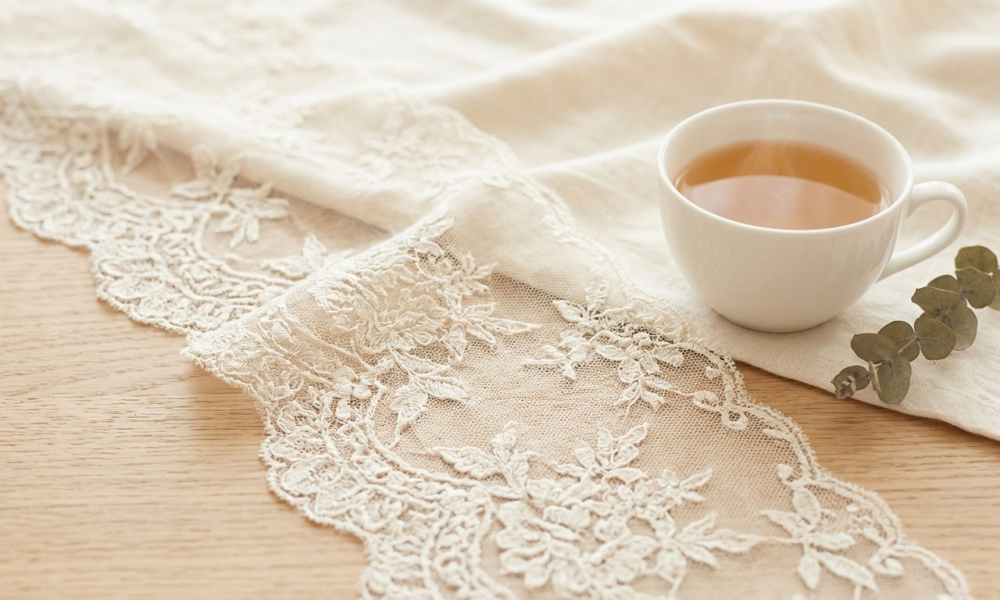
Lace has been made by hand for more than five hundred years. It has dressed royalty, furnished cathedrals, edged the sleeves of portraits hanging in museums. And yet place it against a concrete wall, a steel table, a minimalist interior with clean soffits and poured floors, and it does not look out of place. It looks intentional. It looks modern. This is the quiet genius of lace — it does not belong to any era. It belongs to every room that needs something human in it.
Heritage Without Weight
The patterns in fine lace carry centuries of accumulated craft knowledge — the geometry of Venetian needlepoint, the florals of Belgian bobbin work, the delicate grounds of French Chantilly. But this history does not arrive as burden. It arrives as depth. A room with lace in it has a layer that rooms without it simply lack — a sense that someone, at some point, chose carefully. That feeling transfers to everything around it.
The Contrast That Completes
Modern interiors are built on hard materials. Glass, steel, stone, poured concrete — surfaces that photograph beautifully and wear well and ask very little of the people who live among them. What they lack, often without anyone noticing until it is supplied, is softness. Not warmth in the temperature sense, but warmth in the human sense — a reminder that the space is inhabited rather than occupied. A single piece of lace does this work with remarkable efficiency.
Made to Last, Designed to Evolve
High-quality lace does not go out of style because it was never entirely in it. It exists slightly outside the cycle of trend — too specific to be fashionable in the seasonal sense, too refined to ever feel dated. Buy it for one room and it will follow you through several. Choose it for one garment and it will outlast the occasion it was made for. This is what five hundred years of continuous production looks like.
Some things survive every era because they were never limited to one.