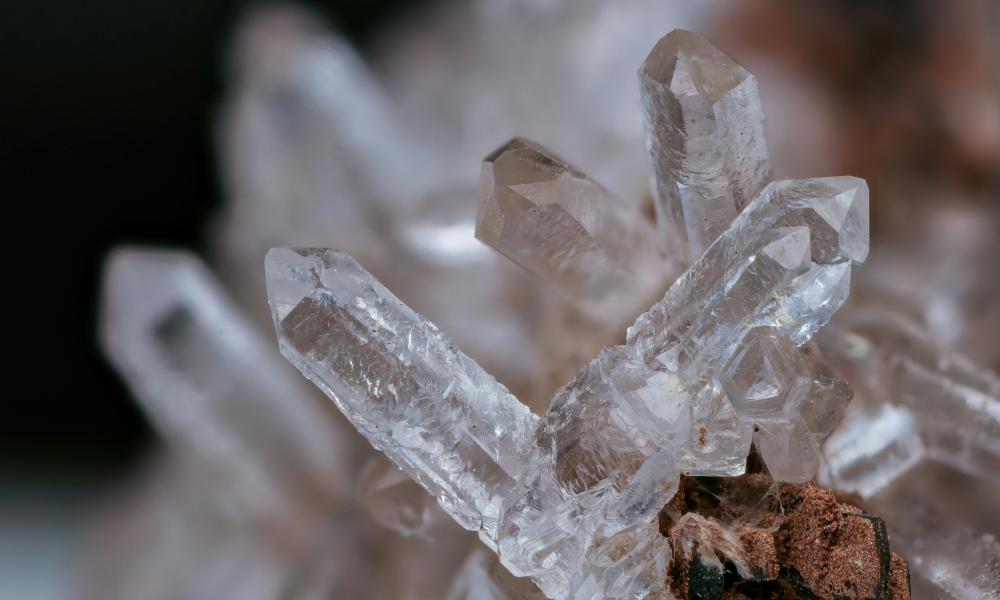
Every natural crystal has a provenance — a specific place, depth, and set of conditions that produced it and no other. This geography is not incidental to what the stone is. It is constitutive of it. The crystal from a Brazilian mine and the crystal from a Madagascan deposit may share a mineral classification, but they carry different histories, different inclusions, different internal structures. They are, in any meaningful sense, different objects.
What the Earth Records
The interior of a natural crystal is a geological archive. The inclusions suspended within it — mineral threads, fluid pockets, fracture planes healed over by continued growth — each record a specific event or condition in the crystal’s formation history. A needle of rutile caught in quartz marks the moment when titanium-rich fluid passed through the growing crystal. A phantom — the ghost of an earlier crystal shape preserved within a larger one — records a pause in growth followed by a resumption under changed conditions. A zone of deeper color marks a period when the mineral environment shifted, leaving a visible boundary between one chapter of the stone’s history and the next.
These records are not decorative. They are accurate. The stone does not embellish or simplify its history. What is inside it is precisely what happened, preserved in three dimensions at a scale that remains legible millions of years later. No manufactured material carries this kind of record, because no manufacturing process operates on these timescales or under these conditions.
Reading the Surface
The exterior of a well-polished natural crystal bead is the end of a long process of geological growth and human refinement — a surface that began as raw mineral matrix and was gradually worked down to the smooth, slightly warm sphere that sits on the wrist. The polish is the final intervention, but the character beneath it is entirely the stone’s own. Variations in translucency across the surface of a bead reflect variations in the internal structure. Areas of greater clarity indicate regions of more uniform crystal growth. Areas of slight haziness or depth indicate zones of finer internal structure, where the light is scattered rather than transmitted directly.
Learning to read these surface variations is not a specialist skill. It is the habit of looking with some attention rather than simply registering the overall impression — and it makes the bracelet a more interesting object to own, because it reveals more the longer it is examined.
A Different Object in Every Light
The geography of a natural crystal produces a bracelet that is genuinely variable — not inconsistent in quality, but responsive in character. In strong directional light, the refractive surfaces activate and the bracelet becomes almost luminous. In diffuse indoor light, it settles into a quieter depth. In candlelight, the warmth of the flame is picked up and returned in a softer register. The stone is the same object in each of these conditions. Its response to them is different, and the difference is determined entirely by what the Earth put inside it.
No two stones tell the same story. Find the one that speaks to you.