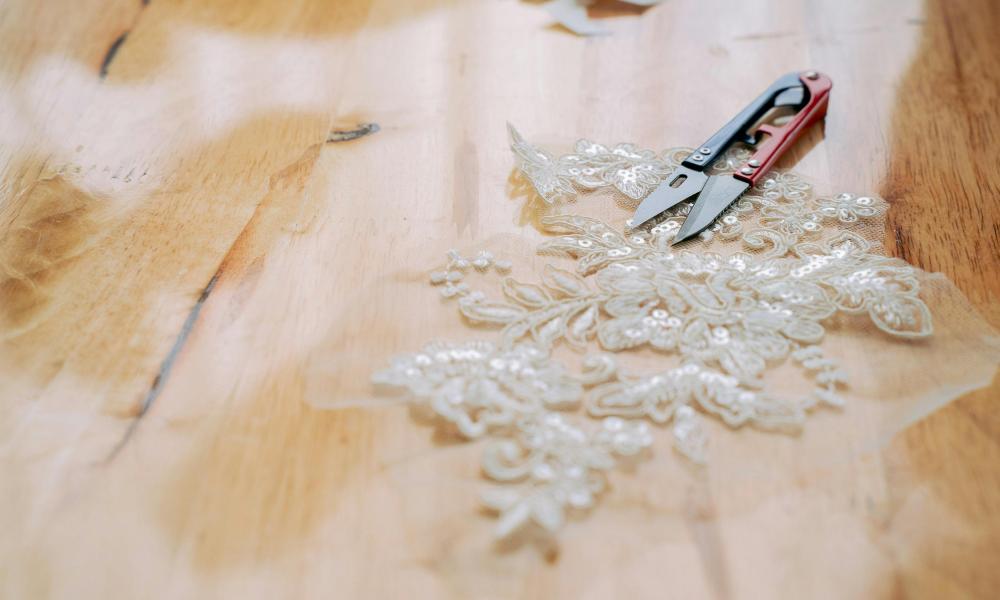
It is possible to look at a piece of fine lace and see only the result — the delicate pattern, the interplay of thread and void, the finished elegance of the whole. It is more rewarding to look closer, and see the process. Every motif in a handmade or high-quality machine lace is the product of decisions made at a scale almost too small to follow — choices about thread weight, about the sequence of operations, about which void to create next and how large to leave it. Understanding this process does not diminish the beauty of the result. It deepens it considerably.
The Logic of the Repeat
Fine lace is built on a repeating unit — a motif, or a combination of motifs, that tiles across the fabric according to a logic established at the design stage. In Chantilly lace, this repeat is typically organic: floral elements and trailing vines that connect across the gr
ound in a pattern that reads as continuous rather than modular. In geometric lace traditions, the repeat is more explicit — a visible rhythm of angles and intersections that gives the fabric its characteristic regularity.
Understanding the repeat helps in choosing lace for specific applications. A large repeat requires sufficient fabric width and length for the pattern to complete itself at the edges of a garment or furnishing — cutting into the middle of a motif produces a result that reads as unfinished. A fine, close repeat is more forgiving of arbitrary cuts and works better for trim applications where the full pattern width is not visible.
Thread Weight and Its Consequences
The thread used in lace production determines nearly everything about the finished fabric’s character. Fine thread produces a lace with a delicate, almost transparent ground — the kind of gossamer quality associated with bridal veils and haute couture overlays. Heavier thread produces a fabric with more presence and body, suitable for furnishing applications and garments where the lace needs to hold its shape without an underlying structure.
The cordonnet — the outline thread that defines the edges of motifs in many lace traditions — is typically heavier than the ground thread, creating the slight relief that gives fine lace its three-dimensional quality when held to the light. This is the detail that distinguishes a well-made lace from a printed or embossed imitation: the actual physical dimension of the outline, visible as a shadow on the surface, felt as a texture under the fingertip.
Why Machine Lace Can Still Be Fine Lace
The association of quality with hand production is understandable but not absolute. Modern lace-making machinery, operating at extraordinary precision, is capable of producing fabrics that replicate the structural logic of handmade lace — the correct thread weights, the proper ground construction, the authentic cordonnet relief — at a consistency that handwork cannot match and at a scale that makes the fabric available outside of museum collections and couture budgets.
The meaningful distinction is not between hand and machine, but between lace made with attention to the structural principles of the tradition and lace that merely reproduces its visual appearance in cheaper materials. The former, however produced, is worth choosing. The latter, however it is marketed, is not.
Look closely. The craft is always visible to those who know where to look.