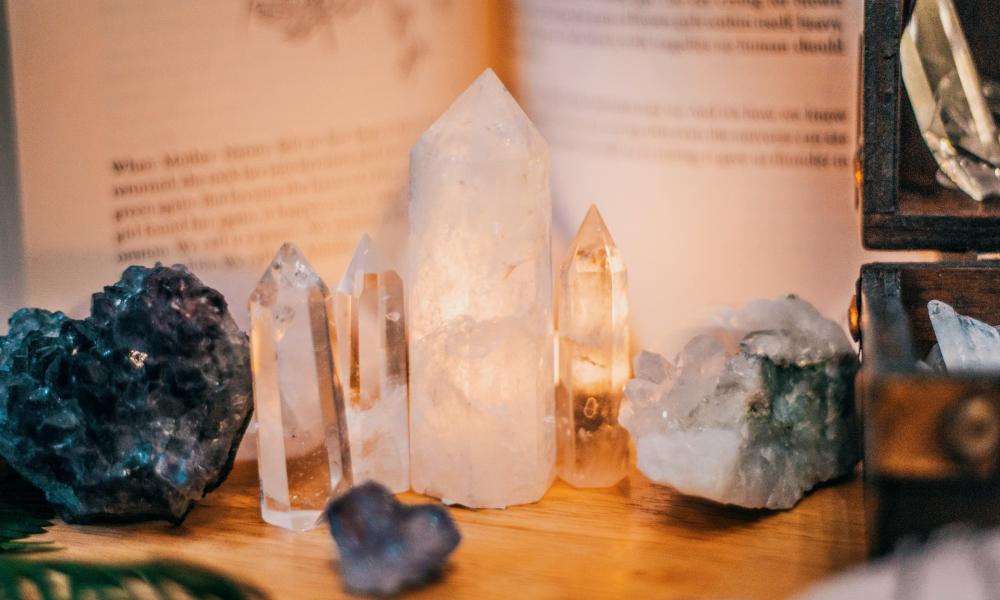
There is a moment, familiar to anyone who has held a natural crystal up to the light, when the stone seems to wake up. The surface, which appeared solid and static a moment before, suddenly reveals depth — layers of internal structure, traces of color, the ghost of a fracture that caught and held a spectrum. The stone does not change. The light does not change. Only the angle changes, and the stone shows you something it was keeping for exactly this moment.
The Physics of Inner Light
What happens when light enters a natural crystal is a function of the stone’s internal geometry — the precise angles of its crystalline lattice, the refractive index of the mineral composition, the presence and position of inclusions that scatter and redirect incoming light before it exits the stone. The result is a behavior that no surface finish or coating can replicate: light that appears to come from within the stone rather than simply reflecting off it.
This inner luminosity is the quality that distinguishes natural crystal from glass, resin, and synthetic alternatives at a glance — and even more clearly in movement. A natural crystal bracelet worn on the wrist catches light differently with every movement of the arm, every shift of position, every change in the ambient light of the environment. It is never static, never finished, never fully revealed. This is not a design feature. It is a consequence of structure, and structure is something only geology produces.
Color That Lives in the Light
The color of a natural crystal is not a pigment. It is a structural phenomenon — the result of specific mineral inclusions, trace elements, or internal fractures that absorb certain wavelengths of light and transmit others. Amethyst’s purple is the product of iron impurities irradiated over geological time. Citrine’s yellow is a variation on the same chemistry, produced by different conditions. Rose quartz’s blush is attributed to microscopic inclusions of a fibrous mineral that scatters light toward the pink end of the spectrum.
This means that the color of a natural crystal changes with its light source. The amethyst that appears deep violet in daylight shifts toward a warmer red-purple under incandescent light. The clear quartz that seems colorless indoors reveals a slight warmth in direct sunlight. The bracelet is not the same object in different environments. It participates in each one differently, and the participation is always accurate — a response to real conditions rather than a fixed performance.
Wearing Light
A natural crystal bracelet is, in a precise physical sense, a wearable optical instrument — a structure that interacts with the light of whatever environment it inhabits and returns something richer than it received. This is not metaphor. It is what the physics of crystal optics actually produces. The bracelet catches morning light and afternoon light differently. It looks different in a candlelit room than in an office. It reveals more on a clear day than an overcast one. Wearing it is wearing something that is genuinely responsive to the world — and in a material landscape dominated by objects that are not, that responsiveness is worth something.
Some things are most beautiful in motion. This is one of them.